

The Empirical Foundation of Occupy 2.0
Before we built the blueprint for change, we had to prove the mechanics of failure. This Special Issue—Wealth, Opportunity, and the New Social Contract—serves as the empirical bedrock for Occupy 2.0. It subjects current social welfare policy to a rigorous autopsy, revealing that we are attempting to solve a wealth problem with income tools and debt anchors. These peer-reviewed studies provide the Continuum of Evidence required to shift the nation from a Consumption State to a Capability State.
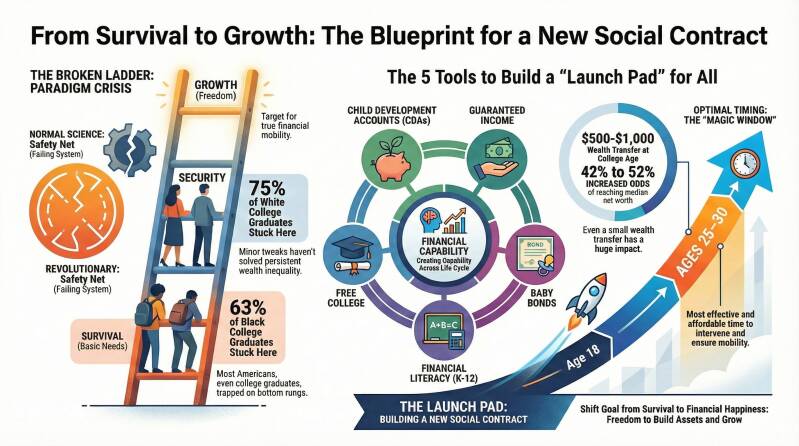
This special issue serves as the intellectual bridge between the theoretical framework of the book, Beyond the Racial Wealth Gap: Structural Class Exclusion and the Case for a Social Mobility Revolution in America, and the actionable demands of the Occupy 2.0 movement. While the book diagnoses the deep structural exclusion and class barriers that have frozen American mobility, this collection of research offers the Social Mobility Revolution blueprint required to dismantle them.
It moves beyond the consumption-based safety net of the New Deal—which merely manages poverty—toward a Financial Capability paradigm. This research demonstrates that the American Dream remains unfulfilled because current policies focus on short-term survival rather than long-term asset empowerment. Situated at the heart of the Occupy 2.0 movement, this special issue provides the data-driven case for a new social contract: one that replaces handouts with a lifelong infrastructure of Child Development Accounts (CDAs), Baby Bonds, and Guaranteed Income to ensure that every citizen, regardless of race or class, has the freedom to pursue financial happiness.
Contents:
- Introduction:American Social welfare Policy from a Financial Capability Perspective
- Return on Degree:Timing Wealth Building to Maximize Return on Degree
- Asset Poverty:Redesigning Social Welfare: Presenting a New Asset Poverty Measure
- Theory Test:Testing a Social Welfare Theory of Financial Capability: Personal and Governmental Capabilities
- Policy Intervention:Ensuring Financial Happiness through an Integrated Social Welfare System
Forthcoming (March timeframe):
New Children’s Development Account (CDA) Book
Bridging the Class Chasm from Day One
While education is a key tool, it is failing because it lacks capital infrastructure. Our upcoming work on Institutional Reservoirs redefines the CDA. We move from the Single Stream Model of individual savings to a Multiple Stream Model where government, philanthropy, and community braid resources together to ensure every child reaches Escape Velocity.